





Building a granny flat is one of the smartest property decisions you can make in NSW right now. It adds usable space, generates rental income, or gives an ageing parent their own comfortable home without leaving the family property. But choosing the wrong builder can turn a great idea into an expensive headache.
The good news? Knowing what to look for makes all the difference. Here are 10 practical tips to help you find the best granny flat builder for your project — so you can build with confidence.
1. Check That They Hold a Current NSW Builder’s Licence
This is the first thing you should do — full stop. In NSW, any builder constructing a granny flat must hold an active contractor licence issued by NSW Fair Trading. It is not optional, and the licence type must match the work being carried out.
Do not just take the builder’s word for it. Visit the NSW Fair Trading licence check tool and search their name or licence number yourself. You are looking for an active licence, not one that expired last year. A builder who cannot provide their licence number upfront, or who deflects the question, is a builder to avoid.
2. Confirm They Carry the Right Insurance
Licensing and insurance are two separate things, and both matter. At minimum, your builder should carry:
- Public liability insurance — covers damage to your property or injuries during the build
- Home warranty insurance (also called home building compensation) — required in NSW for residential work over $20,000, and protects you if the builder dies, becomes insolvent, or disappears before completing the work
Ask to see current certificates for both before you sign anything. A legitimate builder will hand these over without hesitation.
3. Ask for a Fixed-Price Contract
Here is where a lot of homeowners get stung. Some builders give you a rough quote early in the process, then costs creep up once construction is underway. By then, you are committed.
The best granny flat builders work from fixed-price contracts that clearly outline:
- The full build cost
- All inclusions (fixtures, finishes, appliances)
- Any site-specific costs identified during the site inspection
- Approval fees, if managed by the builder
If a builder cannot give you a detailed fixed price after a proper site inspection, treat that as a warning sign.
| Amescorp provides a detailed fixed-price proposal after a free site visit — with all inclusions listed clearly, so you know exactly what you are getting. |
4. Look for a Structural Guarantee
Every reputable granny flat builder in NSW should provide a structural guarantee as part of their contract. Under the Home Building Act 1989 (NSW), the minimum warranties are:
- 6 years for major structural defects
- 2 years for non-structural defects
A quality builder will meet or exceed these minimums and put it in writing. If a builder only gives you a verbal promise, or skims over the warranty conversation, dig deeper before committing.
5. Review Their Portfolio — and Visit Real Projects
Any builder can show you a folder of renders and design concepts. What you want to see is real completed granny flats — with addresses you can physically drive past.
A strong portfolio shows consistency in quality across different sites and design styles. Look for:
- Variety of designs (1-bedroom, 2-bedroom, different architectural styles)
- Projects in similar suburbs or on similar blocks to yours
- Before-and-after photos showing site conditions
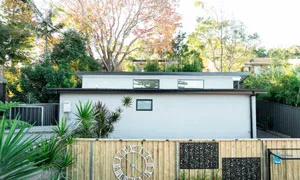
Amescorp has built hundreds of granny flats across Sydney and the Central Coast. Their portfolio includes a wide range of completed projects — worth reviewing before your site visit.
6. Visit a Showroom or Display Flat
Reading about quality finishes is one thing. Standing inside a completed granny flat and seeing the workmanship firsthand is something else entirely. Very few builders offer a physical display — those that do are serious about what they build.
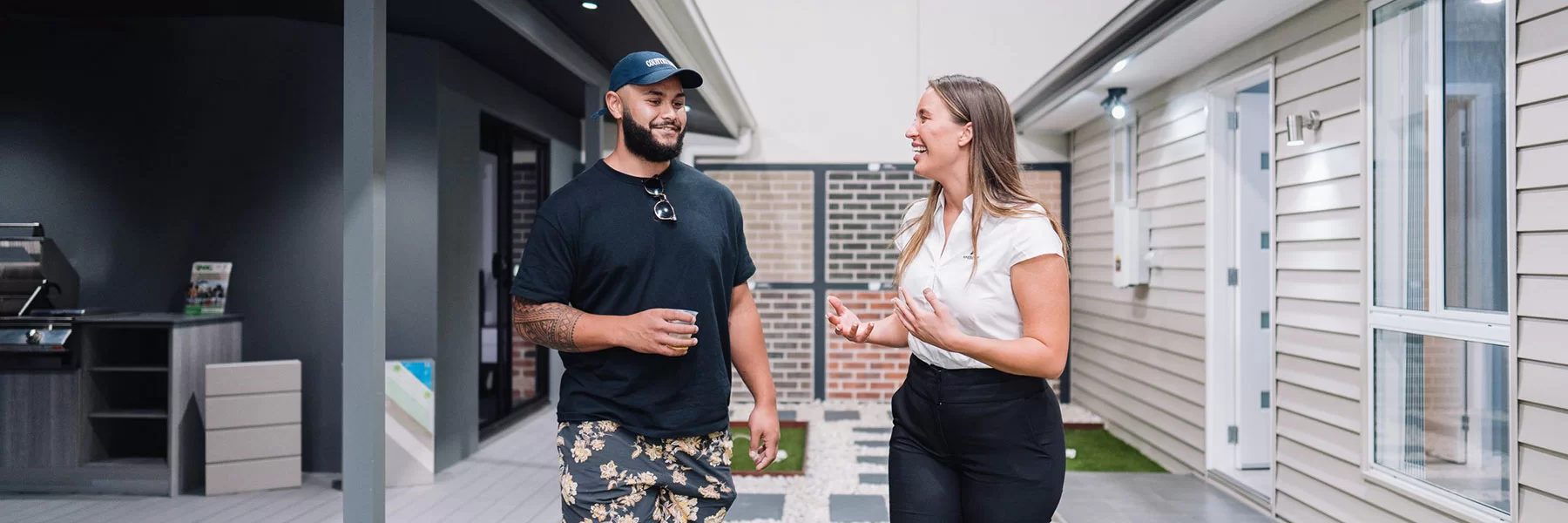
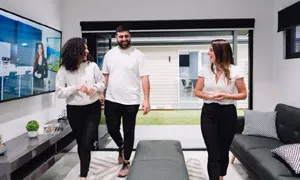
Amescorp has two complete granny flats built in their showroom, which you can walk through before making any decision. You can see the standard inclusions, the finishes, the layout, and the build quality with your own eyes.
| Amescorp Showroom: Visit a complete, fully-fitted granny flat display before committing. Contact the team at (02) 8798 9858 to arrange a showroom visit. |
7. Understand How Approval Works — and Who Manages It
One of the things that catches homeowners off guard is the approval process. In NSW, building a granny flat requires either:
- A Complying Development Certificate (CDC) — assessed by a private certifier, generally faster
- A Development Application (DA) — submitted to your local council, which takes longer
The best granny flat builders manage this entire process for you. They obtain the architectural plans, structural and hydraulic engineering reports, BASIX certificates, and certifier or council approval — all while keeping you informed.
If a builder expects you to handle any part of the approval process yourself, or is vague about how it works, ask specific questions before signing.
8. Ask How They Handle Communication During the Build
A build that goes smoothly is one where the client is kept informed at every stage. Ask any builder you are considering:
- Who is my main point of contact throughout the project?
- How will I be updated on progress?
- What happens if something unexpected comes up on site?
The answer should be clear and specific — not vague. At Amescorp, every client has a dedicated contact who knows the details of their build and can answer questions directly. You should never feel like you are chasing someone for an update on your own property.
9. Compare Quotes Carefully — Cheaper Is Not Always Better
When you receive multiple quotes, resist the temptation to simply choose the lowest number. A quote that looks significantly cheaper than others often means something is missing — either from the inclusions, the materials, or the site costs that will show up later.
When comparing quotes, check:
- Is this a fixed price or an estimate?
- What finishes and fittings are included?
- Are site costs included or charged separately?
- Are approval fees included?
- Is the structural guarantee clearly stated?
A slightly higher quote from a reputable, licensed builder with a strong portfolio and a fixed-price contract will almost always be a better investment than a cheaper quote with vague inclusions.
Understanding Granny Flat Build Costs in NSW
To help you benchmark quotes you receive, here is a general cost guide based on publicly available Amescorp data as at May 2025. These are indicative ranges — your actual cost will depend on your site conditions and design choices.
| Granny Flat Type | Typical Build Cost (NSW) | Notes |
| 1 Bedroom | $160,000 – $180,000 | Most popular entry-level option |
| 2 Bedroom | $170,000 – $200,000 | Suits families or rental income |
| 3 Bedroom | $175,000 – $210,000 | Larger footprint, more materials |
| 2 Storey | $290,000 – $330,000 | Complex build; site assessment required |
| Site costs (variable) | $5,000 – $30,000+ | Slope, soil type, sewer location |
| Council / CDC approval | $3,000 – $8,000 (approx.) | Varies by council and approval path |
| Note: Site costs (slope, soil conditions, sewer location) and approval fees are typically charged separately. Always ask for these to be itemised in your quote. The figures above are industry estimates sourced from amescorp.com.au and may vary. Confirm current pricing with Amescorp directly. |
10. Check Reviews and Ask for References
Online reviews on Google, Facebook, and industry platforms give you an unfiltered view of how a builder actually works with clients. Look for:
- Consistent 4–5 star ratings over a sustained period (not just a cluster of recent reviews)
- Specific mentions of communication, quality, and post-build service
- How the builder responds to any negative feedback
You can also ask the builder directly for references — past clients who are willing to speak with you. A confident, reputable builder will have no hesitation providing these.
Builder Comparison: Green Flags vs Red Flags
Use this quick-reference table when you are assessing any granny flat builder in NSW:
| What to Check | Green Flag ✓ | Red Flag ✗ |
| Licence | Active NSW Builder’s Licence (verify on Service NSW) | No licence number offered or licence expired |
| Insurance | Public liability + home warranty insurance in place | Vague about insurance or can’t provide certificates |
| Fixed-price contract | Signed fixed-price contract with full inclusions list | Quote that changes frequently before contract is signed |
| Structural guarantee | 6-year structural guarantee provided in writing | Only a verbal promise of warranty |
| Portfolio | Real completed projects with addresses you can drive past | Stock photos or renders only |
| Communication | Dedicated point of contact available throughout the build | No clear process for updates or calls |
| Approval management | Builder handles DA or CDC approval from start to finish | You are left to manage council yourself |
| Showroom or display | Display flat available to visit before you commit | No physical evidence of finished work |
The Typical Granny Flat Build Process: Step by Step
Understanding what a professional, end-to-end build looks like helps you evaluate whether a builder’s process matches up. Here is Amescorp’s five-stage process as a reference:
- Online assessment and site review — the builder checks your property details, sewer diagrams, flood information, and zoning before a site visit.
- Site visit and fixed-price proposal — a consultant visits your property, assesses site conditions, and provides a detailed fixed-price quote. You are then invited to visit the showroom.
- Design stage — once you accept the proposal, you work with the builder’s consultant and architect to finalise the design. Changes can be made before moving forward.
- Approval stage — the builder obtains all required plans, engineering reports, BASIX certificates, and DA or CDC approval. You make your material and colour selections during this stage.
- Construction and handover — building begins on your approved plans. Your dedicated contact keeps you informed throughout. On completion, the builder hands over the keys and all documentation.
For a detailed breakdown of Amescorp’s process, visit amescorp.com.au/process/.
Common Mistakes Homeowners Make When Choosing a Granny Flat Builder
Even well-prepared homeowners can make avoidable errors. Watch out for these:
- Not verifying the builder’s licence independently. Always check NSW Fair Trading yourself — do not rely on the builder’s word alone.
- Accepting a verbal quote as a commitment. Nothing is binding until you have a signed, written contract with a full inclusions list.
- Focusing only on the base build price. Site costs, approval fees, and optional upgrades can add significantly to the final cost.
- Skipping the showroom visit. Seeing a finished build in person reveals far more than photos or brochures.
- Not asking about post-build support. Find out who to contact if something needs attention after you move in.
- Rushing the decision. A granny flat is a significant investment. Take the time to compare two or three builders properly before signing.
Frequently Asked Questions
What licence should a granny flat builder have in NSW?
In NSW, any builder constructing a granny flat must hold a current contractor licence from NSW Fair Trading. You can verify this online at fairtrading.nsw.gov.au. Always confirm the licence is active before signing any contract.
How much does it cost to build a granny flat in NSW?
Costs vary by size and site conditions. Based on current Amescorp data, a one-bedroom granny flat typically ranges from $160,000 to $180,000, two-bedroom from $170,000 to $200,000, and three-bedroom from $175,000 to $210,000. Two-storey builds can reach $290,000 to $330,000. Site costs and approval fees are additional. Confirm current pricing with your builder directly.
How long does it take to build a granny flat in NSW?
Once council or certifier approval is in place, construction typically takes around 12 to 16 weeks for a standard granny flat. The approval stage — whether CDC or DA — adds additional time before construction can begin. Your builder should give you a realistic timeline at the proposal stage.
Can I rent out my granny flat in NSW?
Yes. In NSW, a secondary dwelling (granny flat) can be rented to anyone, not just family. You must have the correct approval — either a CDC or DA — in place before renting. Speak with your builder and a solicitor about your specific situation.
What is a fixed-price contract and why does it matter?
A fixed-price contract locks in the total cost of your build before construction starts. It protects you from unexpected cost increases during the project. Look for a contract that itemises all inclusions, site costs, and approval fees — not just the base build price.
Do I need council approval for a granny flat in NSW?
Yes. You need either a Complying Development Certificate (CDC) from a private certifier or a Development Application (DA) approved by your local council. A CDC is generally faster. Your builder should manage this process on your behalf.
What warranty should a granny flat builder provide?
Under the Home Building Act 1989 (NSW), residential builders must provide a minimum 6-year structural guarantee and a 2-year non-structural defects warranty. Ask for this in writing as part of your contract.